Choosing a 3D dental printer is no longer simply a matter of comparing print speed, resolution, or purchase price. For dental clinics and laboratories, the more important question is whether a printer can consistently support the applications, materials, software, and production processes that matter in everyday work.
With the growing adoption of 3D printing for dental applications, available systems now cover a wide range of technologies, configurations, and price points. Understanding the factors behind these differences can help you select equipment that fits your current workflow while leaving room for future applications.
Start With the Dental Applications You Need
Before comparing printer specifications, define what you expect to produce.
Dental 3D printing can support applications such as dental models, surgical guides, occlusal splints, impression trays, denture components, orthodontic models, temporary crowns and bridges, and other dental appliances. Different applications may require different combinations of accuracy, material properties, build volume, and post-processing.
For example, a laboratory producing large batches of models may prioritize build volume and throughput. A clinic producing surgical guides or splints may place greater emphasis on dimensional accuracy and repeatability. If your workflow includes temporary or permanent restorations, material compatibility and validated printing parameters become especially important.
The right printer should therefore be selected according to actual case requirements rather than specifications alone.
Consider DLP and LCD Printing Technologies
The printing technology is another important consideration. DLP and LCD are both used in modern dental 3D printing, but their characteristics can differ in areas such as optical systems, productivity, detail reproduction, and overall operating costs.
DLP technology can be suitable for applications where consistent detail and production efficiency are important. LCD systems can provide detailed prints while offering a practical option for a broad range of dental applications.
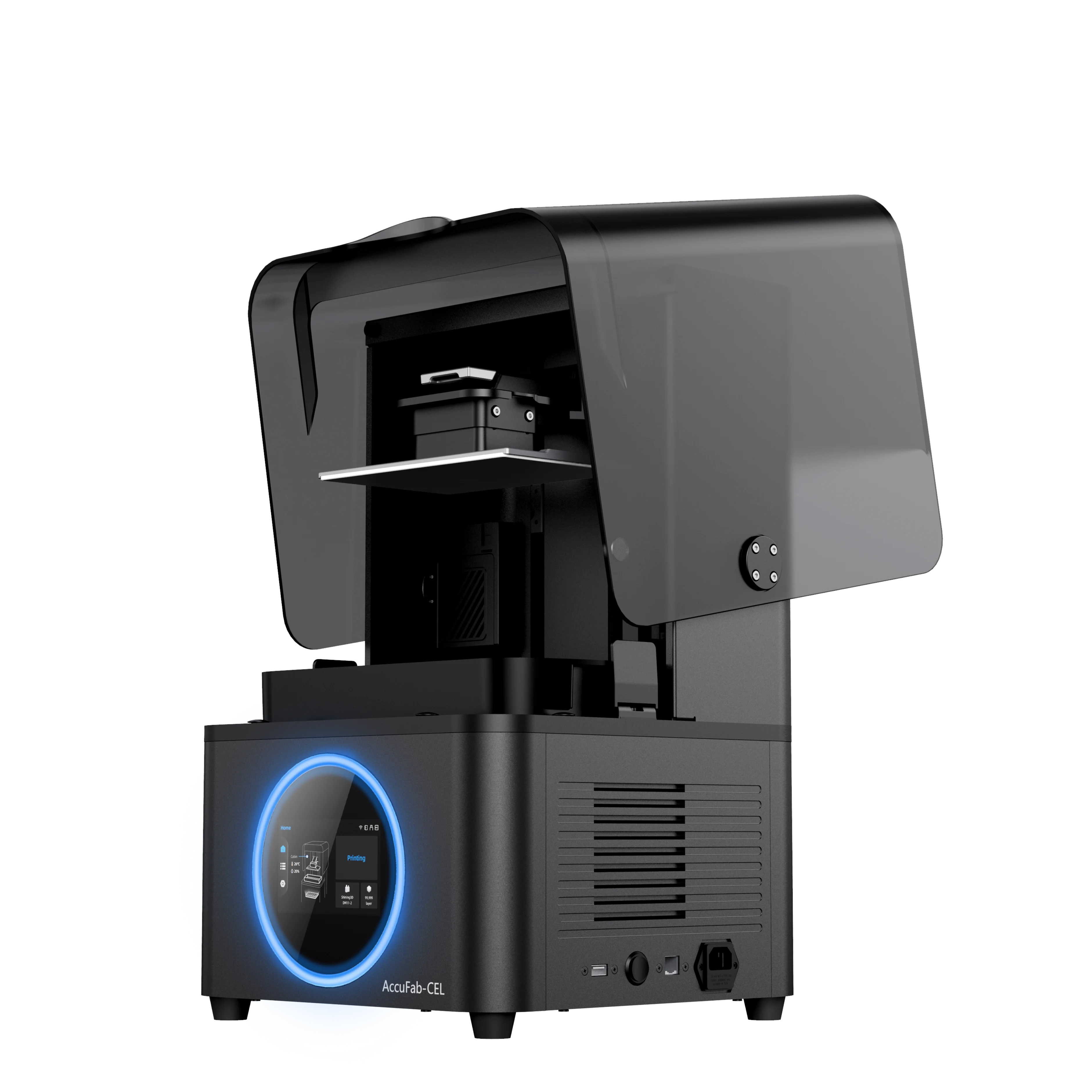
For example, the SHINING 3D DENTAL portfolio includes both DLP and LCD systems. The AccuFab-F1 and Ceramix-Nano use DLP technology, while models such as AccuFab-CEL and AccuFab-Aris use LCD technology. This range allows users to compare different configurations according to their specific workflow requirements.
Rather than assuming one technology is universally better, evaluate how the printer performs on the applications you handle most frequently.
Look Beyond Resolution When Evaluating Accuracy
Resolution is often one of the first specifications buyers notice, but it should not be the only measurement used to evaluate a 3D dental printer.
Dental applications require consistent dimensional results across repeated prints. Factors such as optical performance, calibration, layer thickness, printing parameters, resin characteristics, platform stability, and post-processing can all influence the final result.
For this reason, it is useful to examine the manufacturer’s application data, recommended workflows, and actual dental cases. A printer that produces reliable results across repeated jobs can be more valuable than one that simply advertises a small pixel size or thin layer thickness.
SHINING 3D DENTAL, for example, lists adjustable layer thicknesses of 50 to 100 μm across several printers, while its product portfolio provides different configurations for different production requirements.
Check Material Compatibility Before Buying
Material compatibility can directly affect how useful a printer becomes over time.
A closed system may simplify material management, while an open material system can provide greater flexibility in selecting resins for different applications. If your workflow is expected to expand, compatibility with multiple dental materials may help reduce the need to replace equipment when new applications are introduced.
Materials should also be evaluated according to their intended use. Dental model resin, surgical guide resin, splint resin, denture materials, and crown and bridge materials have different requirements.
SHINING 3D DENTAL provides an open material system and offers dental materials for applications including temporary crowns and bridges, splints, dentures, surgical guides, dental models, impression trays, and orthodontic models.
The key is not simply the number of compatible materials, but whether the available materials match your actual clinical or laboratory needs.
Evaluate the Complete Workflow, Not Just the Printer
A printer is only one part of a digital dental production process. The workflow may begin with an intraoral or laboratory scan, continue through CAD design and print preparation, and then move into printing, washing, curing, finishing, and quality inspection.
If these steps require excessive manual intervention, the printer’s advertised speed may not translate into faster overall production.
This is why integrated software and post-processing equipment deserve attention during the purchasing process. SHINING 3D DENTAL describes its digital dentistry ecosystem as covering scanning, design, printing, materials, and post-processing, with products such as AccuWare software, FabWash, and FabCure systems supporting different stages of production.
When comparing systems, calculate the time required from digital file preparation to a finished part, rather than comparing printing time alone.
Consider Ease of Operation and Maintenance
A technically capable printer still needs to be practical for everyday use.
Consider how easily operators can prepare files, load materials, start jobs, clean components, perform calibration, and complete post-processing. Automated detection features can also reduce operational errors.
For example, the SHINING 3D DENTAL printer comparison includes features such as platform detection, resin tank detection, residue detection, and environmental monitoring on selected models.
The physical footprint also matters. Space may be limited in a clinic or laboratory, so printer dimensions, weight, ventilation requirements, and the location of washing and curing equipment should be considered before installation.
Compare Total Cost Instead of Purchase Price
The initial printer price is only one part of the investment.
A more useful calculation includes materials, post-processing equipment, maintenance, replacement components, labor, training, and the expected number of cases produced over a given period. You should also consider whether the printer’s throughput matches your current workload.
A lower-priced system may make sense for occasional model production, while a higher-capacity solution could be more appropriate for workflows with consistent production demand.
The goal is to find a balance between equipment cost, production capacity, application range, and operational efficiency.
Choose a System That Can Grow With Your Workflow
Dental workflows often develop over time. A printer initially purchased for models may later be expected to support splints, surgical guides, dentures, or temporary restorations.
This makes scalability an important purchasing consideration.
A portfolio with different printer configurations, materials, software, and post-processing options can provide more flexibility as application requirements change. SHINING 3D DENTAL offers multiple printer types and configurations, ranging from compact systems to larger DLP and LCD platforms, alongside a broader digital workflow ecosystem.
The right 3D dental printer should therefore solve today’s production requirements while leaving practical options for tomorrow.
Making a More Informed 3D Dental Printer Decision
Selecting equipment for 3D printing for dental applications requires more than comparing technical specifications. Application requirements, printing technology, accuracy, materials, workflow integration, ease of operation, post-processing, total cost, and future scalability all deserve consideration.
For clinics and laboratories evaluating their options, SHINING 3D DENTAL provides a range of DLP and LCD dental 3D printers, dental materials, software, and post-processing solutions designed to work across different digital dentistry workflows. The most suitable system ultimately depends on the applications you produce, the volume you handle, and the level of workflow integration you require.
