Modern residential architecture increasingly incorporates localized generation assets to counteract rising electrical tariffs and utility grid instability. Sourcing a high-quality Wall-Mounted 51.2V LiFePO4 Home Battery provides a reliable method for homeowners to store clean solar power, secure backup electricity, and lower daily operational expenditures.
Sourcing the proper stationary hardware dictates an accurate assessment of physical chassis dimensions, cell safety chemistry parameters, and automated battery management protocols. Property owners seek low-profile systems that fit cleanly within utility corridors without obstructing regular household operations.
The Crystalline Physics of Residential Chemical Cells
Decentralized power stations rely on distinct chemical formulations that dictate how internal components handle heat, voltage stress, and rapid bidirectional current flows. Lithium Iron Phosphate (LFP) utilizes a robust olivine crystalline layout featuring exceptionally strong covalent atomic bonds. This rigid structural architecture maintains mechanical stability even when the battery module undergoes repeated deep discharging processes.
In contrast, Nickel Manganese Cobalt (NMC) chemistries rely on layered oxide structures that inherently experience more physical expansion and contraction during operation. This structural movement can accelerate internal material fatigue over multi-year deployment periods. The stability of the underlying chemical grid remains a primary consideration for engineering firms designing close-proximity residential projects.
Evaluating Thermal Runaway Thresholds and Gas Release Risks
Thermal runaway represents a critical safety parameter when high-capacity electrical assets operate inside enclosed attached garages or basements. LFP chemistry exhibits a remarkably high thermal runaway threshold, typically resisting decomposition up to temperatures near 270°C. Furthermore, if an external fault triggers a breakdown, the chemical reactions release negligible volumes of oxygen.
Layered NMC compounds break down at significantly lower temperatures, often around 210°C, and release active oxygen during thermal stress events. This internal oxygen release can feed localized combustion pathways, requiring highly complex external fire containment systems. Utilizing high-performance LiFePO4 battery storage configurations fundamentally minimizes these chemical risks without demanding bulky external containment structures.
Structural Engineering for Enclosed Wall Mounted Installations
Securing heavy electrical assets to residential wall panels requires highly precise chassis engineering and robust structural anchoring systems. The external casing must feature heavy-duty protective shells that shield delicate internal battery cells from dust ingress and humidity shifts. Specialized wall brackets must distribute down-force stress evenly across building support beams to reduce long-term shifting.
The structural advantages of LFP also translate into practical benefits for wall-mounted installations. Because LFP cells undergo less volume change during cycling, the internal mechanical stress on the enclosure and mounting hardware is lower over time. NMC cells, with their greater expansion and contraction, place more demanding requirements on the battery management system and thermal management design to maintain long-term structural integrity.
The manufacturing approach from Dyness addresses these structural demands by crafting sleek, low-profile wall enclosures that save space while maintaining high physical durability. This slim housing carries an IP65 protection rating, which helps shield the internal battery components from dust and moisture in garage or basement environments. Well-engineered containment supports reliable hardware performance across diverse residential layouts.
Sub Zero Charge Kinetics and Molecular Resistance
Standard lithium-based storage cells face significant performance challenges when ambient temperatures drop below freezing, as cold environments slow down internal ion movement. At −20°C, lithium plating has been confirmed for cycling LFP cells, while NMC cells also face accelerated degradation under similar conditions. Forcing high charging currents into frozen cells can cause lithium plating on the anodes, creating internal short circuits and early capacity loss. Outdoor installations require proactive climate control systems to maintain safe operating parameters.
However, LFP cells are generally more tolerant of overcharging at low temperatures than NMC cells. In low-temperature environments, the minimum state-of-health fade rates of NCM cells before the turning point can be 1.41 to 3.48 times as high as the maximum SOH fade rates of LFP cells. Reduced chemical activity in cold weather increases internal resistance, which lowers the overall round-trip conversion efficiency of the microgrid. If the system drops below acceptable thermal thresholds, standard battery management systems will halt charging completely to protect the chemistry. Resolving these winter operational halts requires clever mechanical engineering inside the core chassis modules.
Innovative Low Temperature Self Heating Technology
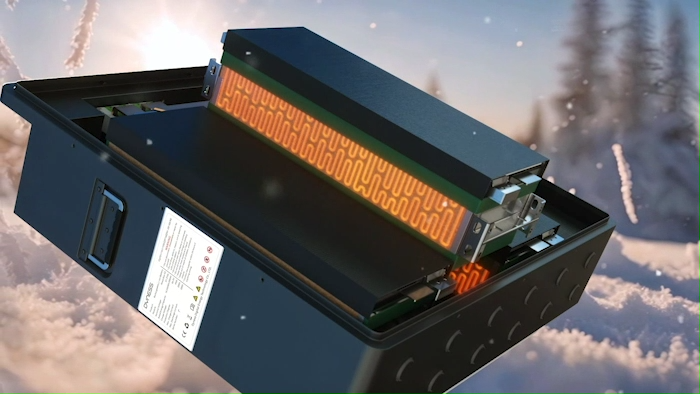
To combat the challenges of freezing climates, advanced energy solutions incorporate internal thermal modification systems that activate automatically based on environmental sensor data. These systems use a small portion of available power to heat the cell matrix to a safe operating zone before allowing high-current charging to begin. Automated thermal pre-conditioning protects the underlying chemistry from structural plating risks.
This approach is particularly relevant for LFP chemistry in residential settings. While NMC offers better cold-weather discharge performance, LFP’s superior thermal stability makes it a safer baseline chemistry. By adding active self-heating, LFP systems can overcome their cold-weather charging limitations without compromising the safety margin that makes them suitable for indoor installation.
For example, the PowerBox G2 wall-mounted system features an innovative low-temperature self-heating technology that activates automatically at -20°C. This mechanism warms the internal battery module up to 0°C within an hour without requiring any manual intervention from the property owner. Active internal warming allows the system to continue storing clean solar energy efficiently through severe winter freezes.
Conclusion
To deploy low-profile residential microgrids successfully, one must select advanced vertical chassis configurations, stable chemical cell matrices, and scalable modular pathways.
Optimized LiFePO4 battery storage architectures paired with innovative low-temperature self-heating technology enable properties to enjoy uninterrupted power 24/7. Through focus-engineering reliable hardware solutions, Dyness delivers the durable, low-maintenance technology platforms required to protect residential structures and achieve complete household grid independence.
