Why precision wire harness manufacturers are now scoping AMR procurement around carrier diversity and API-driven dispatch rather than payload alone, with a deployment from a Taiwan-based top-tier wire harness producer as the operational reference.
May 26, 2026 | About 12 minutes read
Walk through a precision wire harness plant and the first thing that registers is not the lines or the operators. It is the variety of what is being moved between them. A reel of fine electronic wire weighs about 5 kilograms and rolls along smoothly. A bundle of automotive wire weighs around 10 kilograms and arrives tied at both ends. A bin of automotive wire weighs about 30 kilograms and stacks on a cart. A tray of electronic connectors carries dozens of SKUs in compartmentalized boxes that need to land at exactly the right work cell. The plant uses several buildings, and material has to cross between them all shift, every shift.
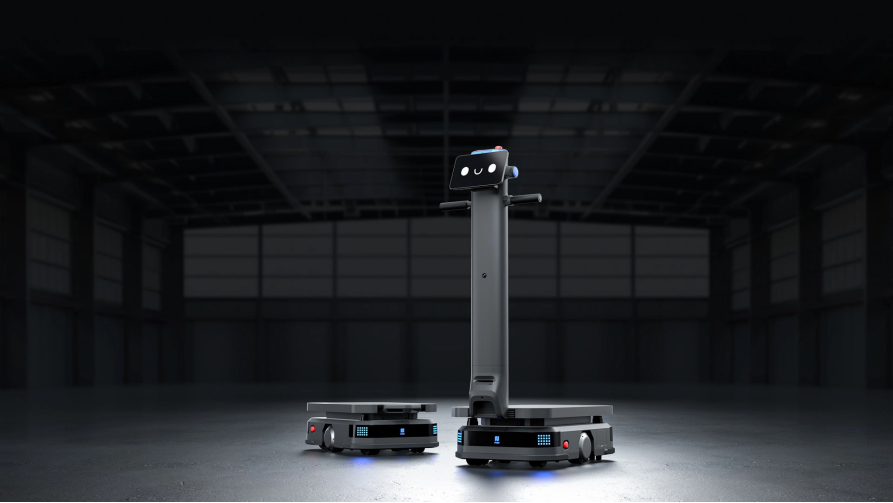
That is the operational context for a recent deployment at a Taiwan-based top-tier precision wire harness manufacturer, a first-tier player in the global precision wire harness segment with multi-billion New Taiwan Dollar annual revenue. The plant deployed a mixed PUDU T300 and PUDU T600 fleet, four units in total, across raw materials warehouse, intermediate staging, semi-automated processing, fully automated processing, and inspection areas. The material flow includes cross-floor delivery, inter-process handoffs, and same-floor inspection runs. Robots are dispatched by API call from the plant’s manufacturing system.
The headline lesson for procurement is not about unit count. It is that wire harness manufacturing is one of the few industrial categories where a single-payload AMR fleet is structurally the wrong shape. Carrier diversity, cross-floor flow, and API-driven dispatch are not bonus features. They are the three procurement criteria that separate a fleet that runs from a fleet that stalls.
Why wire harness plants are quietly becoming an AMR category of their own
Two structural pressures are pushing wire harness plants into the AMR conversation. First, the bill of materials inside vehicles, appliances, servers, and industrial equipment keeps adding electronic content. Industry research firms project the global automotive wire harness market alone running well into the tens of billions of US dollars through the second half of the decade, with similar growth in electronic interconnect for data center, industrial automation, and consumer electronics. Behind those numbers is a steady increase in SKU count per plant, which is the real operational pressure on the floor.
Second, wire harness manufacturing is the rare industrial category that genuinely needs frequent, fine-grained, mixed-payload material movement. The International Federation of Robotics’ 2024 World Robotics report documents continued mobile robot growth in electronics and component manufacturing, but the wire harness sub-category has its own geometry: a single plant moves reels, bundles, bins, and connector trays through the same aisles, with deliveries measured in dozens or hundreds per shift, not in a handful of palletized inter-process runs.
That is why the deployment at the Taiwan-based top-tier producer is worth reading as a category signal rather than as a single procurement decision. It is one of the first deployment patterns to scope an AMR fleet around carrier diversity from day one, instead of buying a single-model fleet and patching the mismatches afterwards.
The deployment pattern: 4 robots, multiple buildings, three carrier types
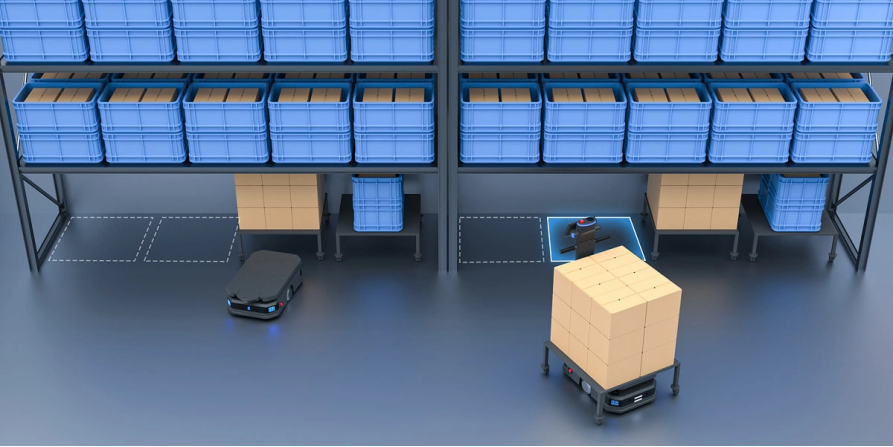
Figure 1. Industrial AMRs handling multi-SKU bulk movement between shelving and cells, the operational shape of wire-harness intralogistics.
Four robots cover the plant’s material flow. Heavier wire harness carriers (bundle form and bin form) move on the PUDU T600 heavy-payload class. Lighter carriers, electronic wire reels and electronic connector trays, run on the PUDU T300, which fits more comfortably in the tighter aisles of the semi-automated and fully automated processing areas. The fleet handles cross-floor delivery between the raw materials warehouse and processing buildings, inter-process handoffs between semi-automated and fully automated cells, and same-floor sample delivery to the inspection area.
Dispatch is API-driven. The plant’s manufacturing system issues delivery tasks to the fleet through an API call, with destination cell, carrier type, and time window encoded in the request. The robots execute. The operators stay at their work cells instead of running parts.
What deserves emphasis is the shape, not just the size. A single-model fleet on this floor would have either oversized the small-carrier deliveries (paying for T600-class headroom on a 5-kilogram reel) or undersized the heavy-carrier deliveries (forcing operators to split bundles or bins manually before handoff). Carrier diversity is what allows a four-robot fleet to serve a plant where a single-model purchase would have needed seven or eight units to cover the same workload reliably.
Carrier diversity is the part most procurement specs underweight
Most industrial AMR procurement starts with a maximum-payload number. The vendor answers in kilograms. The buyer compares spec sheets. That works in categories where carriers are a single shape, like 3PL with pallets or auto-parts with line-side racks. It fails in wire harness, where the carriers are genuinely heterogeneous and the bottleneck on the floor is not weight, it is matching the carrier geometry to a robot that can actually handle it.
The Taiwan deployment illustrates the better procurement lens. The plant has three carrier families with concrete operational definitions:
– Electronic wire reels, primarily reel form, approximately 5 kilograms each. Frequent, small per-task, sensitive to aisle clearance. Handled by T300.
– Automotive wire bundles, bundle form, approximately 10 kilograms each. Heavier per item, larger footprint. Handled by T600.
– Automotive wire in bins, bin form, approximately 30 kilograms each. Stacks on a cart. Handled by T600.
– Electronic connectors, in compartmentalized trays. Multiple SKUs per pickup, route stability matters more than weight. Handled by T300.
Read carefully, that is not a vendor brochure list. It is the procurement criterion. The buyer’s job is to walk the plant, catalog the actual carriers, and then ask the vendor exactly which robot class handles which carrier family, what the cycle time looks like for each, and whether the same fleet can support the inventory of carriers in one preset configuration or whether each new carrier requires a separate integration run.
Cross-floor material flow is a real constraint, not a planning footnote
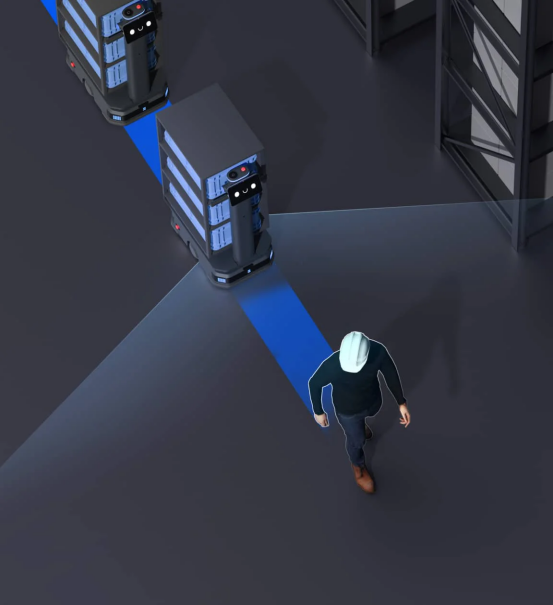
Figure 2. Compact-footprint industrial AMR sharing aisles with operators and equipment in a precision manufacturing environment.
A wire harness plant rarely fits on one floor. The Taiwan deployment moves material across multiple floors and buildings: raw materials warehouse on one floor, intermediate staging on another, processing on yet another. That means the AMR fleet has to share or actuate elevators, navigate transitions between buildings, and stay on a route that respects the building’s pedestrian and operator traffic.
The procurement implications buyers should treat as table stakes:
– Elevator and access control integration: does the vendor have a documented integration path for the plant’s elevator and access control system, and what does the safety review look like?
– Cross-building positioning: does the AMR’s positioning approach (flexible VSLAM in this case, no magnetic tape, no QR codes) hold its accuracy across the geometry shift from one building to another?
– Multi-floor mapping management: can the fleet management software handle multi-map operation with clean handoffs between floors, rather than treating each floor as a separate site?
A vendor that does not have validated cross-floor cases should not be on the shortlist for a wire harness plant. The cost of working around that gap, manual elevator runs, dedicated trans-floor operators, separate fleets per floor, is a hidden operating expense that quickly cancels out the labor savings of the AMR deployment.
API dispatch is what makes a frequent, complex delivery list survivable
Wire harness manufacturing produces an unusually long, high-frequency delivery task list per shift. Trying to dispatch that list manually through a coordinator on the shop floor is the failure mode that converts a successful pilot into a quiet rollback six months later. The procurement-critical capability is API integration with the plant’s manufacturing system, so that the delivery tasks are generated and consumed automatically as part of the production flow.
The Taiwan deployment runs exactly this way. The plant’s manufacturing system makes API calls to the AMR fleet. The fleet executes. Production reporting closes the loop. The shop-floor coordinator role is not absorbed by the deployment because there is no shop-floor coordinator role to absorb.
The procurement question to put to a vendor is, again, concrete. What does the API specification look like? Is it documented and stable? What integration effort does it require from the customer’s IT team versus from the vendor’s solution team? What is the typical timeline for a first integration with a manufacturing system the vendor has not seen before? Buyers who treat API dispatch as a future feature are buying a fleet that needs a human dispatcher; that line item has a way of becoming permanent.
Four operational features of precision wire harness plants that shape robot selection
Pudu Robotics field engineering has now installed T-series industrial robots into wire harness, auto-parts, electronics, and commercial-vehicle plants across multiple countries. Four patterns repeat across precision wire harness sites, and each one changes the calculus for what kind of AMR fits.
1. SKU count and carrier shapes drive procurement, not single-payload weight
Wire harness plants typically carry hundreds of SKUs and multiple carrier families through the same aisles. Single-payload procurement misses the carrier dimension entirely, which is where most failed deployments quietly stall. The right opening question for procurement is the carrier catalog, not the maximum payload number.
2. The environment is complex by default
Wire harness production floors mix semi-automated cells, fully automated cells, manual workstations, and inspection areas in close proximity. Operator traffic is constant. Carts, dollies, racks, and trays share the aisles. Compact footprint, omnidirectional perception including low and suspended obstacle detection, and tight-corner navigation are entry criteria. Robots that need 1.2 meters of clear path will not run in a real wire harness plant.
3. Multi-floor and multi-building operation is normal
Unlike many auto-parts and electronics plants, wire harness plants frequently use several floors and several buildings within the same campus. AMR procurement should assume cross-floor operation from day one, with elevator integration, multi-floor mapping, and validated cross-building positioning accuracy on the requirements list rather than the wish list.
4. Task volume and frequency are higher than buyers expect
The delivery task list in a precision wire harness plant is often several times longer than a comparable auto-parts or electronics plant, because the SKU count is higher and the per-cell delivery cadence is faster. API dispatch from the plant’s manufacturing system is the only realistic mechanism for handling that volume reliably. Manual dispatch is an interim arrangement at best, and a structural bottleneck at worst.
Workflows in a wire harness plant that fit a mixed T300 + T600 fleet
Once you accept that the entry shape is a mixed fleet driven by carrier diversity and API dispatch, the next question is which workflows the fleet should cover. The matrix below summarizes the workflows where a mixed low and mid-payload industrial AMR fleet fits cleanly in a precision wire harness environment.
| Workflow | Carrier example | Robot class | Why this allocation |
| Cross-floor raw material delivery to processing | Electronic wire reels, ~5 kg each | T300 | High frequency, small per-task, sensitive to aisle clearance; T300 footprint fits semi-automated cells. |
| Cross-floor raw material delivery to processing | Automotive wire bundles, ~10 kg each | T600 | Larger carrier footprint; T600 payload headroom keeps cycle time stable across full bundle sizes. |
| Cross-floor raw material delivery to processing | Automotive wire in bins, ~30 kg each | T600 | Bin form factor and heavier load fit the T600 class natively; no manual splitting required. |
| Inter-process handoff between semi-automated and fully automated cells | Mixed carriers | T300 + T600 by carrier | Carrier-to-robot mapping holds across the handoff; no per-handoff reconfiguration. |
| Same-floor sample delivery to inspection | Multi-SKU connector trays | T300 | Routing precision and tray geometry matter more than weight. |
| Empty carrier return to staging | Empty reels, bundles, bins | T300 or T600 by carrier | Returns combine naturally with the outbound legs into closed loops. |
| Bulk WIP transfer between major buildings | Pallet-class carriers | Project-dependent | Validate per route; may need additional capacity beyond the entry fleet. |
Table 1. Workflow and carrier fit matrix for a mixed T300 + T600 fleet in a precision wire harness plant.
The first six rows are the natural entry workflows for a precision wire harness plant. They share four properties: predictable carrier sizes, standardized handoff points, API-driven task generation, and a clean cross-floor route plan. The Taiwan deployment lands directly in those rows.
What the T300 and T600 contribute operationally
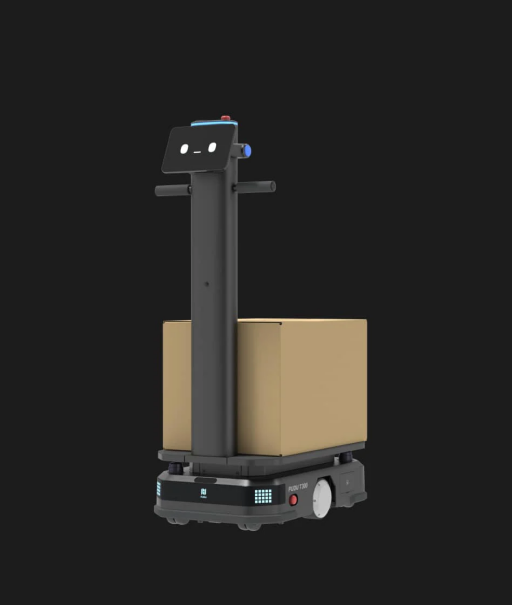
Figure 3. Industrial AMR using a jacking lift to transfer a parts rack, the mechanism used for reels, trays, and lighter carriers in the wire harness plant.
The PUDU T300 is built for tight, complex industrial aisles: a 300 kg payload class with a low profile, flexible VSLAM positioning that does not require magnetic tape or reflectors, layered perception combining upward and downward RGBD with dual lidar, around 60 cm path clearance, ISO 3691-4 conformant safety, and 24/7 operation. Inside this deployment it carries reels and connector trays through the tightest aisles in the semi-automated and fully automated cells.
The PUDU T600 extends the same engineering philosophy to a heavier payload class: up to 600 kg payload, jacking-lift and traction capability, the same flexible VSLAM positioning and layered perception stack, and the same fleet management. Inside this deployment it carries automotive wire bundles and bins across the cross-floor and cross-building routes, with the headroom to handle full carrier loads without manual splitting at the warehouse.
The procurement-critical detail is that both robots run on the same fleet management software and the same API. A buyer is not stitching together two separate vendor stacks; they are scoping one fleet across two payload classes. That is what keeps the operating cost of mixed-fleet deployment within reach of a four-robot project, instead of an enterprise rollout.
Where Pudu Robotics fits in the global industrial AMR landscape
Wire harness procurement teams reasonably want to know who they are buying from before they put a fleet across multiple floors and buildings of a working plant. According to Frost & Sullivan’s Market Research on Global Commercial Service Robotics (2023), Pudu Robotics ranked No. 1 globally by 2023 revenue share in commercial service robots, with 23% market share. KEENON Robotics held 11%, Gausium 8%. For a wire harness buyer, that signal matters as a deployment-base signal: the vendor has the install base to harden product, the service depth to support multi-site operations, and the engineering capacity to keep iterating on both T-series payload classes and the unified fleet management that lets mixed deployments stay simple.
Inside that portfolio, the T-series industrial robots are the entry point for manufacturing environments, with T300 and T600 sharing one fleet stack and the same engineering philosophy across payload classes.
What wire harness procurement teams should evaluate next
If the deployment pattern described in this article fits your plant, the most useful next step is a carrier-catalog audit and a single-building validation against the canonical cross-floor flow, with an explicit replication plan to additional plants or buildings if the validation passes.
From there, four questions decide whether a mixed-fleet AMR procurement is the right shape:
– Have you cataloged the carrier families in your plant by form factor and weight, and mapped each family to a robot class on the vendor’s spec sheet?
– Does the vendor have validated cross-floor and cross-building deployment cases, including elevator integration with a comparable plant?
– Is the AMR fleet drivable from your manufacturing system via documented API, with a realistic first-integration timeline?
– Does the vendor cover both the small-carrier and the heavy-carrier payload class on the same fleet stack, with one fleet management interface and one service contract?
The answers tend to resolve into a tight first project per plant, not an enterprise platform purchase. That is the right shape for a category where carrier diversity, cross-floor flow, and API dispatch are the actual constraints.
FAQ
Why is wire harness manufacturing a mixed-fleet category rather than a single-model category?
Because the plant carries genuinely heterogeneous carrier families (reels, bundles, bins, connector trays) through the same aisles, and a single payload class either oversizes the small carriers or undersizes the heavy ones. A mixed T300 and T600 fleet matches the carrier inventory directly; a single-model fleet would have needed roughly twice the unit count to cover the same workload reliably.
How important is API dispatch in practice?
It is the single biggest predictor of whether a high-frequency delivery list stays reliable. Manual dispatch through a coordinator is feasible for pilot volumes; it does not survive production volumes with hundreds of tasks per shift. A documented, stable API on the vendor side is procurement-critical, not optional.
Can the same fleet run cross-floor reliably?
Yes, when the vendor provides elevator integration, multi-floor mapping, and validated cross-building positioning. The Taiwan deployment in this category does exactly that, running between raw materials warehouse and processing buildings without separate fleets per floor.
Does this replace operators?
The credible business case is operator redeployment, not labor elimination. Operators stay at their work cells instead of running parts. Headcount usually adjusts through normal attrition and process redesign, while the cells absorb the productivity gain.
How should we evaluate vendors beyond the spec sheet?
Three checks separate viable vendors from optimistic ones: a documented carrier-to-robot mapping for a comparable wire harness plant, a validated cross-floor case with elevator integration, and an API specification (with a sample integration timeline) that can drive the fleet from your manufacturing system. If any of those three is missing, the vendor is selling a single-payload product into a mixed-fleet category, and the operating cost will reflect that mismatch.
References & Further Reading
1. Frost & Sullivan. Market Research on Global Commercial Service Robotics (2023). https://www.frostchina.com/en/content/insight/detail/66b96cfadce2a58aa58ac492
2. International Federation of Robotics. World Robotics 2024. https://ifr.org/
3. TechSci Research. Global automotive wire harness market reports. https://www.techsciresearch.com/
4. Taiwan Electrical and Electronic Manufacturers Association (TEEMA). Taiwan electronics industry indicators. https://www.teema.org.tw/en/
5. Pudu Robotics. PUDU T300 industrial autonomous mobile robot. https://www.pudurobotics.com/en/products/pudut300
6. Pudu Robotics. PUDU T600 industrial autonomous mobile robot. https://www.pudurobotics.com/en/products/pudut600
7. Pudu Robotics. Smart manufacturing case study, multi-robot collaboration. https://www.pudurobotics.com/en/case-studies/pudu-tri-robot-battery
