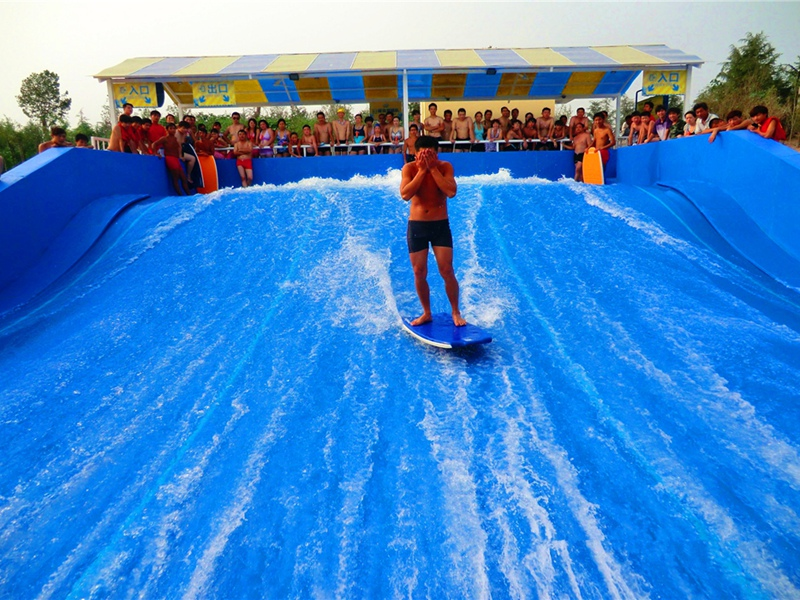
A sheet-flow surfing attraction lets a rider work against moving water instead of travelling along a long flume. That difference changes the first spatial question: the venue needs a defined riding zone and a workable arrangement around it. A surf machine begins a different layout discussion from a conventional slide.
An area estimate also needs a boundary. The rider’s surface, equipment support areas, guest circulation and shared venue facilities occupy different parts of the plan. Establishing what is included in the proposed footprint is more useful than applying one unqualified area figure to every possible installation.
Let the Riding Principle Define the First Zone
One relevant format for a stationary wave machine uses a fast sheet of water directed upwards across a riding surface. The participant works against that flow. It is a different arrangement from generating successive large waves that travel through a conventional pool, so the spatial comparison needs the correct attraction type.
The riding zone is consequently a defined activity area, with a relationship to the positions from which people approach, observe and leave it. The proposed use of the surrounding floor needs to be considered with the attraction, because those adjacent activities continue while riding takes place.
A viewing position and an access route perform different jobs. Combining their areas without examining how people use them can conceal a conflict in the layout. Marking each function separately makes it possible to discuss the relationship before the arrangement is treated as a finished equipment position.
The operating concept provides the starting information for that exercise. Intended participation, neighbouring attractions and the venue’s existing routes establish what must connect with the riding zone. The resulting drawing can then distinguish the equipment boundary from the space required to use the attraction within the venue.
Separate Custom Riding Area from Venue Allowances
A water slide maker reviewing a mixed attraction scheme needs to distinguish the different equipment formats on the plan. A surfing area, a slide landing arrangement and the route between attractions cannot be treated as interchangeable allocations simply because they all belong within the same aquatic venue.
Jinchao‘s Surfing Simulator uses a pressurised system and nozzles to move water upwards over a soft waterproof surface. Its surfing-area dimensions are customised to the venue. That provision establishes the need for a specific layout, without implying that the selected riding area accounts for every supporting function.
The space schedule for a surf machine can therefore separate the custom riding zone from waiting, circulation and technical access. Shared changing rooms, lockers, first aid and staff facilities belong elsewhere in the venue schedule. Their availability and relationship with the attraction still need to be identified.
Shared facilities require particular care in area comparisons. A room already serving the venue may also serve the proposed attraction, but its floor area cannot be counted as unused space for equipment. Recording the existing function keeps the usable attraction area distinct from the property’s total area.
Reserve Routes for Service and Delivery
Space beside a stationary wave machine can have a technical purpose as well as a guest-facing one. Inspection and maintenance require a workable approach to the relevant equipment. The proposed service arrangement needs to remain recognisable after surrounding attractions and decorative features have been positioned.
The brief supplied to a water slide maker can show which routes are shared and which serve technical work. A connection that passes through a busy guest area presents a different operating arrangement from a dedicated service approach. The equipment proposal needs to be assessed in its intended setting.
Delivery introduces another route through the venue. Access openings, turns, temporary storage and movement towards the installation position need consideration before the permanent arrangement is settled. The path used to receive equipment may differ from the paths that guests will use once the attraction opens.
These routes also interact with later development. Reserving a future equipment position has limited value if the only approach becomes obstructed. An expansion drawing can retain the connection needed to reach and service the proposed area, while leaving the eventual attraction selection open.
Check the Proposed Boundary in Three Dimensions
A plan for a surf machine needs to relate its horizontal boundary to the surrounding built space. Columns, level changes and overhead structures can affect the arrangement. A three-dimensional review connects those conditions with the selected equipment, without assuming that an outline on the floor resolves them all.
For a Flowrider Surf Simulator, the agreed proposal can identify the riding area, technical interfaces and surrounding access as separate items. Project-specific equipment information then gives those items meaning. A dimensional answer becomes useful when its scope can be located on the actual venue drawing alongside existing rooms and connecting routes.
Site and budget shape the designs developed by Jinchao. Discussion with the water slide maker can use measured venue information to connect that service with the proposed surfing attraction. The question is how the chosen equipment and its supporting functions will occupy the space available for the project.
The area accepted in the layout needs to accommodate riding, waiting, movement and technical attention. Each function has a visible position and a relationship with its neighbours. Shared facilities then appear once in the area schedule, with their relationship to the new attraction recorded alongside them.
